St Bride – John Duncan

John Duncan was an artist of the Celtic revival with a distinctly symbolist style. I saw this painting, St Bride, at the Scottish National Gallery in Edinburgh on New Year’s Day and was immediately captivated by the rich colours and the extravagant details of the angels’ robes. Apparently, it’s a depiction of the Irish saint, Bride, being carried to the Holy Land by angels so that she could witness and assist with the birth of Christ, then becoming his foster mother in the Celtic sense. It wasn’t a legend I’ve heard before but it’s a beautiful one, reflecting the importance of the custom of fosterage in Celtic Christian societies.

Being a symbolist painting though, Duncan’s St Bride doesn’t dwell on the end goal, the lowly stable in Bethlehem. That would be far too direct. The symbolists always aimed to implicitly evoke an effect rather than to explicitly represent a cause. It’s typical that the painting should focus on passage and transition rather than concrete arrival and achievement – it’s very modern in that respect. But St Bride is distinctly less modern in other respects: eyes closed, hands clasped in prayer, Bride (or Brigit as I’ve always known her) abandons herself wholly to the care of the angels, displaying a very old-fashioned (or possibly timeless) certainty and trust in the care of God. And the angels carry her with such delicate tenderness! Their hands don’t grip, clench or force, they support Brigit, almost caressing her. One angel looks back at her with an expression of concern, the other stares forward, eyes fixed on an unseen target – the Lord takes care of our present and our future. We, like Brigit, need only rest in His arms (or the arms of His angels) and trust that He will take us where we need to be. Not very modern at all.

As an aside, it’s funny how any work of art that makes me gasp with love on sight – as this one did – almost always turns out to be in some way connected with symbolism, and it’s funny how often these symbolists turn out have some Christian or Catholic feeling, even if the artists themselves did not practise. I think it comes from the symbolists’ belief in the importance of dreams, imagination and the spirit – the seed of the Divine is sown in all these things and when you seek to cultivate them, if you do not vanish down a rabbit hole of sensuality, self-obsession and ultimate self-destruction (as happened with many of the poètes maudits, the proto-Symbolists), you may well see that seed sprout and flower into beauty, as it did for John Duncan.
Regularity in Private Prayer

“It is very easy to be religious by fits and starts, and to keep up our feelings by artificial stimulants; but regularity seems to trammel us, and we become impatient. This is especially the case with those to whom the world is as yet new, and who can do as they please. Religion is the chief subject which meets them, which enjoins regularity; and they bear it only so far as they can make it like things of this world, something curious, or changeable, or exciting. Satan knows his advantage here. He perceives well enough that stated private prayer is the very emblem and safeguard of true devotion to God, as impressing on us and keeping up in us a rule of conduct. He who gives up regularity in prayer has lost a principal means of reminding himself that spiritual life is obedience to a Lawgiver, not a mere feeling or a taste.

– John Henry Newman

Private Prayer

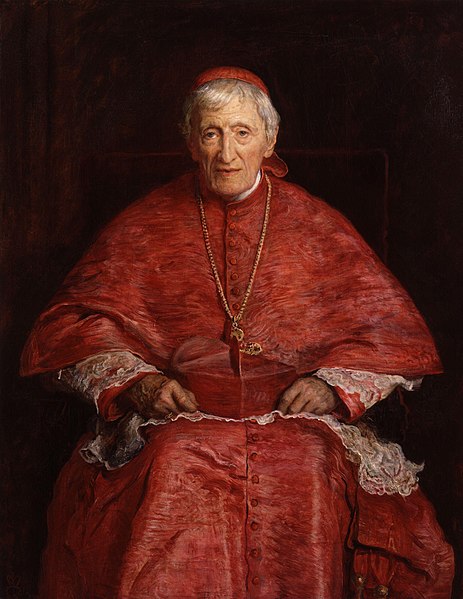
File:John Henry Newman by Sir John Everett Millais, 1st Bt.jpg
John Henry Newman by Sir John Everett Millais

“It is easy to see why [private prayer] is irksome; because it presses upon us and is inconvenient. It is a duty which claims our attention continually, and its irksomeness leads our hearts to rebel; and then we proceed to search for reasons to justify our own dislike of it. Nothing is more difficult than to be disciplined and regular in our religion. It is very easy to be religious by fits and starts, and to keep up our feelings by artificial stimulants; but regularity seems to trammel us, and we become impatient.”


– Bl. John Henry Newman

Source

Shadow Over My Soul

“Toward the end of the first year of my novitiate, darkness began to cast its shadow over my soul. I felt no consolation in prayer; I had to make a great effort to meditate; fear began to sweep over me. Going deeper into myself, I could find nothing but great misery. I could also clearly see the great holiness of God. I did not dare to raise my eyes to Him, but reduced myself to dust under His feet and begged for mercy.”

– St. Faustina, Divine Mercy in My Soul

Prayer to St. Joseph the Worker

Glorious St. Joseph, 

model of all those who are devoted to labour,

obtain for me the grace to work conscientiously,

putting the call of duty above my many sins;

to work with thankfulness and joy,

considering it an honour to employ and develop,

by means of labour,

the gifts received from God;

to work with order,

peace, prudence and patience,

never surrendering to weariness or difficulties;

to work, above all,

with purity of intention,

and with detachment from self,

having always death before my eyes

and the account which I must render of time lost,

of talents wasted,

of good omitted,

of vain complacency in success

so fatal to the work of God.

All for Jesus,

all for Mary,

all after thy example,

O Patriarch Joseph.

Such shall be my motto in life and death.

Amen.